◆sections
Method
The method is the contribution: no number is reported for a code path that has not been proven equivalent to the reference path, and no experiment reports a result without a pre-declared failure criterion and a matched control arm.
Parity-gated benchmarks
For each of burst = 8 distinct suffixes sharing one prefix, the harness compares final-token logits from the cold path (recompute prefix + suffix from scratch) against the warm path (clone the prefix cache, continue from absolute position prefix_len). The gate requires all three of: max |delta logit| <= 2e-2, KL(cold || warm) <= 1e-5, and top-1 agreement on every suffix. verify_state_reuse.py exits non-zero and suppresses all timing output if the gate fails. A measured speedup is therefore only ever printed for a path already proven numerically equivalent to recompute.
- Parity gate thresholds and exit behaviour
research/paper_f51_darwin_x_2026.md:94-100 · verified - Timing output suppressed when the gate fails
research/paper_f51_darwin_x_2026.md:100 · verified
Negative control on the parity test
A parity test can pass vacuously if the model ignores its context. A third test therefore asserts that dropping the prefix entirely - precisely what the earlier benchmark did - MUST change the logits (max |delta| > 1e-3). A further test asserts the memory scaling claim directly: attention KV must grow with a 4x token increase while SSD state stays byte-identical.
- Negative control: dropping the prefix must change logits by more than 1e-3
src/tests/test_btb_state_reuse_parity.py:130-148 · verified - SSD state must stay byte-identical while attention KV grows
src/tests/test_btb_state_reuse_parity.py:151+ · verified - Rationale stated in the test module docstring
src/tests/test_btb_state_reuse_parity.py:1-13 · verified
Causal-mask pitfall (why the gate exists)
With a populated KV cache where k_len > q_len, PyTorch's F.scaled_dot_product_attention(is_causal=True) aligns its triangular mask to the TOP-LEFT of the [q_len, k_len] score matrix. A suffix query at absolute position p is then permitted to attend only to the first few prefix tokens, so the cached prefix is silently discarded and no error is raised. The fix builds the mask from absolute positions. Before the fix, warm and cold logits diverged by ~5.6e-2; after it, by ~1e-6.
- Mechanism of the top-left alignment bug
research/paper_f51_darwin_x_2026.md:76-82 · verified - Absolute-position mask fix, with the code
research/paper_f51_darwin_x_2026.md:84-92 · verified
Prefix state reuse in a hybrid SSD/attention model
The hybrid cache splits into two parts. Attention layers (GQACausalAttention) hold per-layer k and v tensors that concatenate as the sequence extends, so size is O(N). SSD layers (SSDMixerOnly) hold per-layer conv_state and ssm_state obtained via block.ssd(..., return_state=True), so size is O(1) in sequence length. The benchmark asks whether reuse is correct and what the cache actually costs, on one device.
- Cache model per layer type
research/paper_f51_darwin_x_2026.md:63-74 · verified - Scope exclusion: no multi-GPU, no RDMA, no burst routing policy, no test-time training
research/paper_f51_darwin_x_2026.md:49-52 · verified - Deterministic random init (seed 51), no checkpoint loaded - parity is a statement about the algebra of the cache and is weight-independent
research/paper_f51_darwin_x_2026.md:111-114 · verified
Cryptographic neuron catalog with hash identity
Every FFN intermediate neuron is stamped with SHA-256, giving per-neuron cryptographic identity alongside a statistical label. Labeling uses split-half reliability with Cohen's kappa per layer, a Welch t-test per neuron (factual vs syntactic), and Bonferroni correction (|t| > 4.8). The scanner explicitly refuses to label a neuron it cannot decide on rather than emitting a naked label.
- 196,608 FFN neurons x 24 layers x 3 matrices stamped with SHA-256
governance/docs/F51_DARWIN_BLUEBOOK.md:24-33 · documented, artifact not in public repo - 95.2% decisive agreement on factually-labelled neurons; 48.7 s scan on a single consumer GPU
governance/docs/F51_DARWIN_BLUEBOOK.md:112-113 · documented, artifact not in public repo - Statistical method per neuron: split-half kappa, Welch t, Bonferroni
governance/docs/SESSION_2026-07-30.md:14-20 · documented - Scanner refuses to label undecided neurons (ABSTENTION); an earlier version labelled all 196,608 with f > s, so a dead neuron would pass
research/scan_ffn_neurons.py:2,22 · verified
Surgical weight editing (ROME / MEMIT) with verified rollback
Knowledge is installed by rank-1 weight edit rather than fine-tuning. The implementation is a proper ROME: v* optimised by gradient descent (not a fixed direction), covariance matrix C = E[kk^T] over a neutral corpus, key averaged over 14 bilingual EN+PT templates, applied as W' = W + (v* - Wk*)(C^-1 k*)^T / (k*^T C^-1 k*). Each edit is bracketed by SHA-256 before and after, and rollback must restore the original hash bit-exactly. MEMIT is the multi-layer variant, spreading over 12 layers with a calibrated lambda of 1.5 per layer.
- ROME formula and bilingual key averaging
governance/docs/SESSION_2026-07-30.md:22-31 · documented - Every weight change must have a SHA-256 before and after; every edit must be exactly rollback-able
governance/docs/F51_DARWIN_BLUEBOOK.md:86-87 · verified (stated as project law) - Edits go into FFN down_proj matrices only; attention weights, embeddings and norms are never touched
governance/docs/F51_DARWIN_BLUEBOOK.md:94 · verified (stated as project law) - MEMIT spreads over 12 layers, lambda 1.5 per layer
governance/docs/SESSION_2026-07-30.md:40-45 · documented
Three integrity gates: verify-then-emit
The paper's contribution is a stance, not a primitive: when validity cannot be established, produce nothing - not a flagged result, not a warning alongside a number, no artifact. Three gates implement it. (1) MEMORY: a persistent key-value store holds encoded keys k = f_theta(h); restoring records into a module whose theta differs encodes the query with one projection and compares it against keys written by another. This does not raise, it returns scores. The gate binds two facts into the snapshot and checks both on load - the digest of the payload, and a fingerprint of the encoders that wrote the keys. (2) PROVENANCE: operations that preserve function under the permutation symmetry of hidden units (selection, permutation, scatter, drop) are exactly the operations that preserve the scalar byte values of the parameters, which makes a cryptographic hash a sound inheritance certificate for precisely the legal operations. The ledger therefore requires each weight record to carry either a provenance digest (claiming inheritance) or a measured drift (admitting manufacture) - never neither. The class is derived from evidence, not from the method name. (3) ABLATION: arms are typed CONTROL, SHADOW, APPLY; SHADOW computes and records the intervention the system would have applied and applies nothing, so the counterfactual is inline in the same run and the same ledger. A registration contract requires all three arms to agree on base_checkpoint_id, data_cursor, seed and training_contract_id; on any mismatch it raises and no output directory is created.
- Memory gate: payload digest + encoder fingerprint, both checked on load; the failing path returns 1.000 -> -0.007 instead of raising
governance/docs/PAPER_REFUSE_NOT_REPORT.md:128-149 · verified - Memory gate implementation raises on missing digest, digest mismatch, and different encoders
src/f51_darwin/cognition/memory.py:285,290,299 · verified - Memory gate tests: different encoders refused, digest mismatch refused, no snapshot_sha256 refused, tampering with a weight outside the initial sample changes the fingerprint
src/tests/test_memory_snapshot_integrity.py:70,102,114,129,148 · verified - Provenance gate: certificate XOR drift; naming a bijection forbids nonzero drift because byte-identical weights cannot have drifted
governance/docs/PAPER_REFUSE_NOT_REPORT.md:151-176 · verified - Provenance gate implementation refuses a record carrying neither certificate nor drift, and refuses nonzero drift under a bijection
src/f51_darwin/transplant_16b/ledger.py:113-124 · verified - Ablation gate: arm identity contract over base_checkpoint_id, data_cursor, seed, training_contract_id
src/f51_darwin/organism/causal_bus.py:143-165 · verified - Ablation gate: on mismatch it raises and no output directory is created
governance/docs/PAPER_REFUSE_NOT_REPORT.md:185-194 · verified - PRE_LOSS phase admits only (LOSS_TERM, SET_SCALE): an illegal self-modification is unspeakable in the grammar rather than rejected
src/f51_darwin/organism/causal_bus.py:26,58 · verified - A gate found a defect on first activation: one memory record covered two targets, expert gate_proj was copied from the donor while the router weight of the same record was zeroed - both recorded under function_preserving: true
governance/docs/PAPER_REFUSE_NOT_REPORT.md:178-182 · verified
Pre-declared failure criteria
Every experiment in section 4 of the paper had its success and failure criteria written into the artifact before the measurement. The governing roadmap states the failure criterion explicitly and in advance: if the graft does not beat a norm-matched noise control, the hypothesis falls - that is a result, not a defeat. The three failure arms are mandatory: real donor / norm-matched noise / no graft.
- Failure criterion declared in advance, plus mandatory three-arm design
governance/docs/ROADMAP_RECEPTOR_UNIVERSAL.md:12-14,66-72 · verified - Both transfer experiments were stopped at the pre-declared failure criterion rather than tuned toward a positive
paper PDF, section 4.4 (published version, 10 pp.) · verified in published PDF
Results
Three classes of measured numbers: parity and cache scaling, speedups that only exist because the parity gate passed, and one prominent speedup that died when the gate was introduced.
Parity holds: the warm path is numerically equivalent to full recompute
RTX 5060 Ti, src/configs/darwin_x_100m.yaml, 153M parameters, burst = 8, suffix = 16 tokens. Residual divergence is float non-associativity: the cold path sums prefix and suffix contributions in one pass, the warm path sums them across a concatenation boundary. Three orders of magnitude below the gate.
| Prefix tokens | Parity | max abs delta | KL | top-1 |
|---|
| 128 | OK | 1.0e-06 | 2.44e-07 | 8/8 |
| 512 | OK | 1.0e-06 | 2.43e-07 | 8/8 |
| 1024 | OK | 2.0e-06 | 4.72e-07 | 8/8 |
| 2048 | OK | 2.0e-06 | 2.43e-07 | 8/8 |
- Parity table
research/paper_f51_darwin_x_2026.md:122-129 · verified - Same numbers in the raw recorded output, all_parity_ok: true
research/btb/state_reuse_results.json:6-79 · verified
Hybrid cache scaling: 684 KiB constant vs 3.0 KiB/token
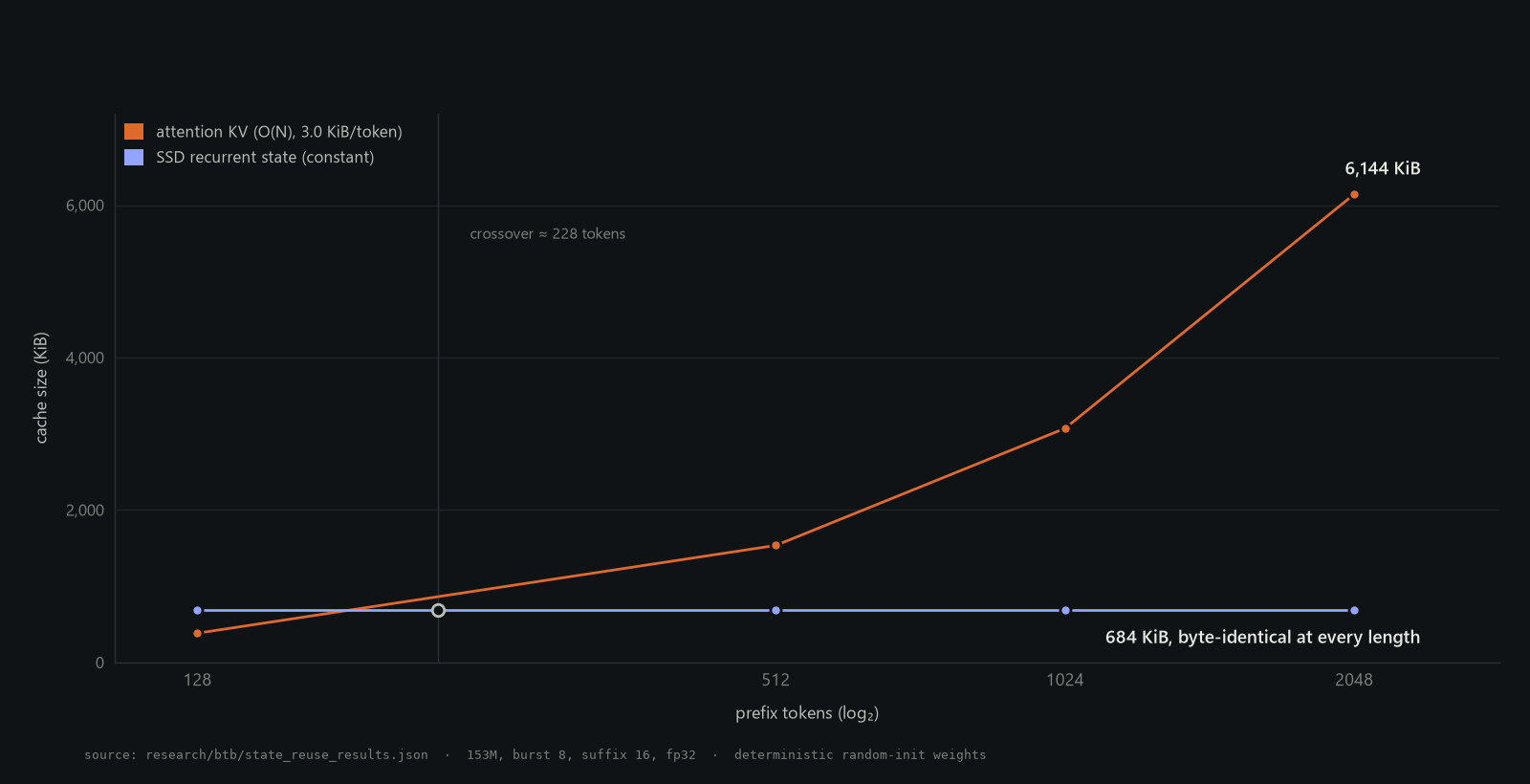
Attention KV is exactly linear at 3.0 KiB/token (3 attention layers, n_kv_heads = 2, head_dim = 64, fp32). SSD state is byte-identical across a 16x range of prefix lengths. Crossover is at ~228 tokens (684 / 3.0): below it the SSD state is the larger of the two, so for short prefixes the hybrid design COSTS memory relative to a pure-attention cache. At 2048 tokens the SSD half is 10% of the total cache; the attention half still dominates and still grows linearly. The report's own conclusion is blunt: a hybrid model does not have an O(1) cache - it has an O(N) cache with a smaller constant.
| Prefix tokens | Attention KV | SSD state | Total |
|---|
| 128 | 384 KiB | 684 KiB | 1068 KiB |
| 512 | 1536 KiB | 684 KiB | 2220 KiB |
| 1024 | 3072 KiB | 684 KiB | 3756 KiB |
| 2048 | 6144 KiB | 684 KiB | 6828 KiB |
- Cache scaling table and the crossover argument
research/paper_f51_darwin_x_2026.md:135-153 · verified - Raw bytes: ssd_state_bytes identical at 700416 for all four prefix lengths; attn_kv_bytes 393216 -> 6291456
research/btb/state_reuse_results.json:16-19,35-38,52-55,68-71 · verified
Speedups, reported only under a passing parity gate
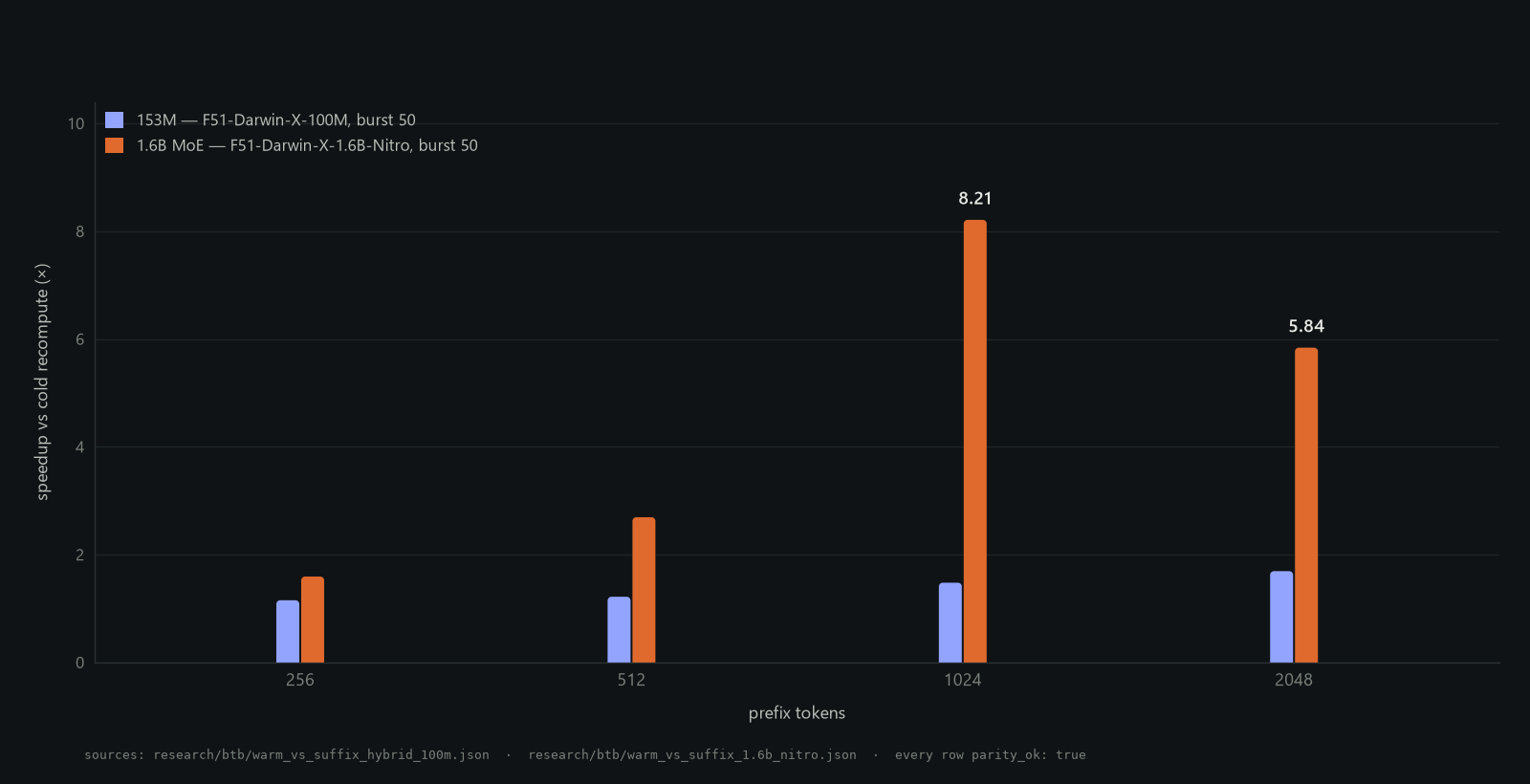
Three model sizes, one device (RTX 5060 Ti). At 517M the burst is 50 requests over 32-token suffixes, min-of-10 with global warmup; warm cost per request is flat at ~146-158 ms regardless of prefix length, because the suffix work is constant and the prefix is paid once. At 1.6B MoE the non-monotonic profile at 2048 tokens is consistent with expert-load imbalance under random weights and is attributed to a weight-initialisation artifact, not a structural limit.
| Model | 256 | 512 | 1024 | 2048 | Parity |
|---|
| 153M, batched dispatch | 1.15x | 1.22x | 1.48x | 1.69x | OK |
| 517M (darwin_x_600m) | 3.69x | 7.42x | 12.30x | 18.57x | OK |
| 1.6B MoE (darwin_x_1.6b_nitro) | 1.59x | 2.69x | 8.21x | 5.84x | OK |
- 153M table with batched dispatch
research/paper_f51_darwin_x_2026.md:168-176 · verified - 153M raw: spd_real 1.1548 / 1.2194 / 1.4799 / 1.6946, parity_ok true on every row, KL ~2.4e-07
research/btb/warm_vs_suffix_hybrid_100m.json · verified (exact match to paper) - 517M table with batched dispatch, burst of 50
research/paper_f51_darwin_x_2026.md:183-192 · published; exact source JSON not in the checkout - see missing - 1.6B MoE table
research/paper_f51_darwin_x_2026.md:197-204 · verified - 1.6B raw: spd_real 1.5940 / 2.6946 / 8.2121 / 5.8405 - exact match to the paper's table
research/btb/warm_vs_suffix_1.6b_nitro.json · verified (exact match to paper) - 519M raw recorded outputs, two runs: spd_real 4.28 / 6.98 / 10.82 / 24.45 and 6.23 / 10.86 / 11.89 / 18.64
research/btb/warm_vs_suffix_600m.json and research/btb/warm_vs_suffix_600m_batched_dispatch.json · verified as raw data; neither matches the published table exactly
The dead 57% result
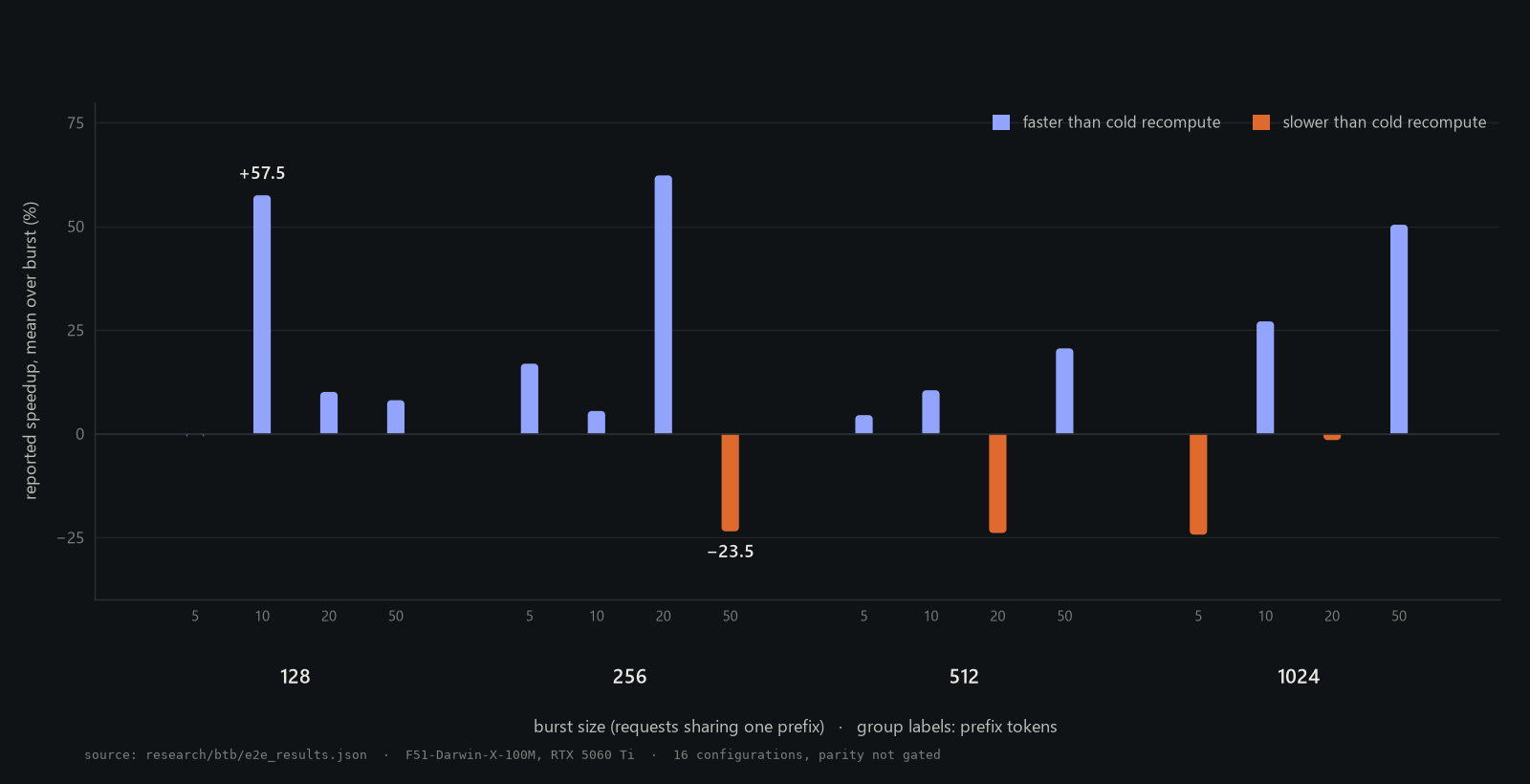
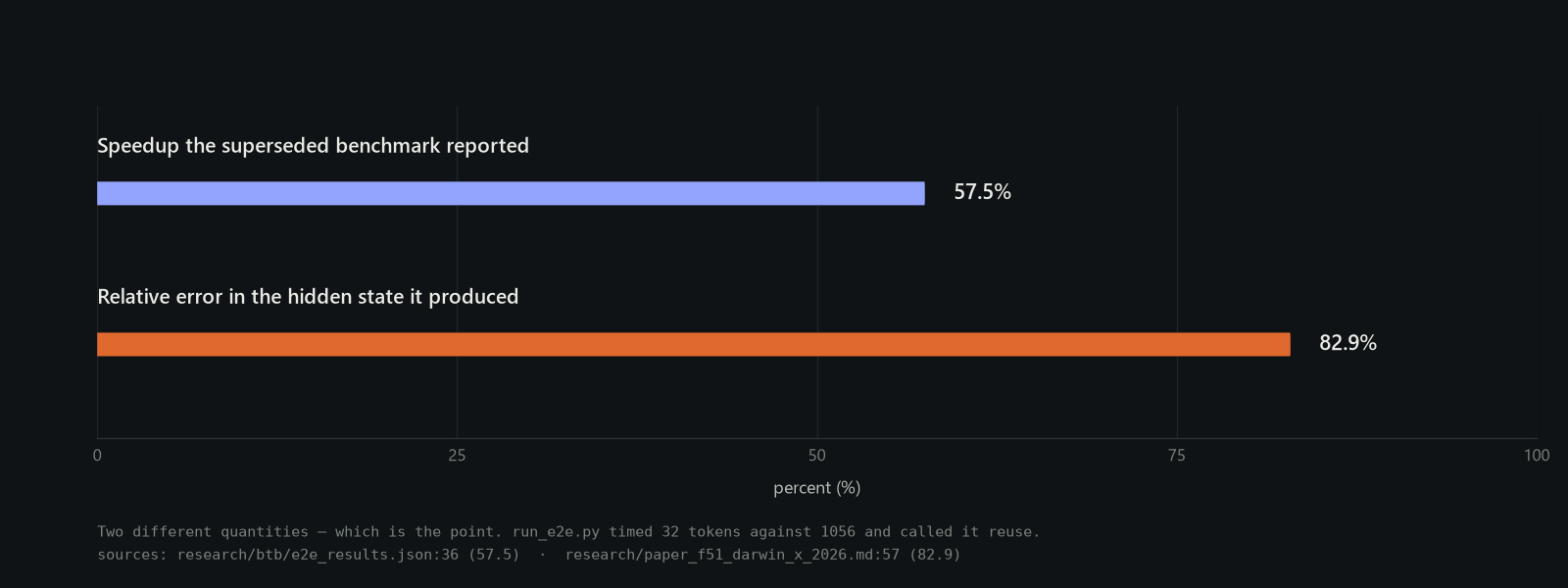
This is recorded here because it is the single strongest piece of evidence for the method. An earlier benchmark in the same repository (research/btb/run_e2e.py) reported speedups of 50-62%. Its warm path called the model on the suffix ALONE and stored a placeholder dict in place of the cache. It therefore measured "processing 32 tokens is faster than processing 1056", not prefix reuse at all, and the resulting hidden state differed from the true one by 82.9% relative error. The failure was invisible in the timing numbers. The specific headline number is recorded in the artifact: 57.5% mean speedup at prefix 128 tokens, burst size 10, cold_mean 2326.4 ms against warm_mean 989.0 ms. The same artifact shows the instability across neighbouring configurations of the same family - -0.0%, 57.5%, 10.1% and 8.1% at prefix 128 with burst sizes 5, 10, 20 and 50, and -23.5% at prefix 256 burst 50. A number that swings from +57% to -24% across a neighbouring parameter is not a measurement. Nothing in the current repository reports that figure as a result; the parity gate that replaced it suppresses timing output on failure, and the requirement is written into the test that guards it.
| prefix | burst | cold_mean_ms | warm_mean_ms | reported speedup |
|---|
| 128 | 5 | 2588.4 | 2589.3 | -0.0% |
| 128 | 10 | 2326.4 | 989.0 | 57.5% |
| 128 | 20 | 2619.7 | 2356.2 | 10.1% |
| 128 | 50 | 2578.6 | 2368.5 | 8.1% |
| 256 | 50 | 831.4 | 1026.6 | -23.5% |
- The 57.5% figure and its neighbours, verbatim from the artifact: speedup_mean_pct -0.0 at line 14, 57.5 at line 36, 10.1 at line 58, 8.1 at line 80, -23.5 at line 168
research/btb/e2e_results.json:14,36,58,80,168 · verified - Cause: warm path called the model on the suffix alone and stored a placeholder dict in place of the cache; 82.9% relative error in the hidden state
research/paper_f51_darwin_x_2026.md:54-59 · verified - The superseded script is documented as measuring only "fewer tokens = faster"
research/btb/state_reuse.py:4 · verified - The guard test states the old benchmark proved no reuse at all
src/tests/test_btb_state_reuse_parity.py:3-10 · verified - The old script is still present in the repository and still listed on the operational surface
research/btb/run_e2e.py and governance/audit/policy/operational-surface.json:189 · verified
Calibration: certified self-reassembly of a 1.7B model
Nothing had calibrated the transplant apparatus against a known answer, so SmolLM2-1.7B was rebuilt from itself, tensor by tensor, certifying every copy under the identity bijection. This exists to license the two negatives that follow: a null from a transplant experiment is only informative once the apparatus is known to reproduce a model exactly.
| measured | required |
|---|
| tensors certified 219 / 219 | 100% |
| KL vs donor, max over 10 prompts 4.13e-08 | < 1e-06 |
| max absolute logit error 0.0 | - |
| top-1 agreement 1.0 | - |
| ledger records, chain reverified 219 | - |
- Calibration table
published paper PDF, section 4.1 (10-page version, SHA-256 3819550CF3DDDC8453A50EA95868E16F9103ECA6433CD63D6CF06F7475DEB527) · verified in published PDF - Negative control inside the artifact: exactly one tensor of 219 already matched the donor before its copy step, traced to tied embeddings and alphabetical ordering; had the target secretly been the donor, all 219 would have matched
published paper PDF, section 4.1 · verified in published PDF - Harness code: verify_inheritance per tensor, certificate validity recorded per tensor, drift recorded as l2 0.0 measured on byte_identity
research/reassemble_certified.py:180-194 · verified - Pre-declared criterion: KL exactly 0 against the original and a valid certificate on 100% of tensors
governance/docs/ROADMAP_RECEPTOR_UNIVERSAL.md:48-58 · verified
Negative 1: cross-lineage FFN graft does not beat noise
The FFN of TinyLlama-1.1B was grafted into SmolLM2-1.7B as gated extra capacity at five layers. Both have d_model 2048; an FFN expert maps residual to residual and never sees a token, so the divergent vocabularies (32k vs 49k) are irrelevant by construction - the donor tokenizer was never loaded. Only the routers were trainable: 10,245 parameters out of 1,884,401,669. The result is a null with a strong internal positive: the graft demonstrably applied, the router learned to distinguish real donor signal from noise and opened its gate for it - and what came through neither helped nor hurt measurably.
| Arm | held-out perplexity |
|---|
| A - real donor FFN | 11.2166 |
| B - norm-matched noise | 11.2163 |
| C - no graft | 11.2168 |
- Graft arms and perplexity table; router gate 0.773 (A) against 0.015 (B); trainable parameter count
published paper PDF, section 4.2 · verified in published PDF - Root cause recorded in advance and confirmed: donor residual basis correlation identity 0.175 against 0.178 chance
published paper PDF, section 4.2; governance/docs/ROADMAP_RECEPTOR_UNIVERSAL.md:69-71 · verified - Harness implements the three mandatory arms A real / B norm-matched noise / C none
research/graft_cross_family.py:35-38,87 · verified - Basis-alignment probe is the source of the 0.175 / 0.178 figure
research/probe_donor_basis_alignment.py:19-21,54 · verified (method present; numeric artifact not in repo)
Negative 2: rank-1 fact installation produces an attractor, not associations
Sixteen facts the donor answers and the receptor does not were installed one at a time by rank-1 edit with an optimised value vector, against an unedited control set. Three of sixteen installed against a required minimum of eight. The failure is not lost capacity: the edited model still emits the correct tokens across much of the control set. What the edit installed is an unconditional attractor - every answer opens with the same spurious name, including on questions unrelated to any installed fact. Sixteen keys in one layer overlap into a constant bias rather than sixteen gated associations. In five of eighteen controls the attractor drags the output into degenerate repetition; in others it replaces the subject entirely. Full-parameter rollback returned a hash-identical model.
| measured | required |
|---|
| facts installed 3 / 16 | >= 8 |
| control set 18 -> 4 | >= 17 |
| full-parameter rollback hash identical | - |
- Fact-installation table and the attractor failure mode
published paper PDF, section 4.3 · verified in published PDF - Both transfer experiments are low-powered by design - 80 router steps, sixteen facts, one layer - and were stopped at the pre-declared failure criterion rather than tuned toward a positive
published paper PDF, section 4.4 · verified in published PDF - The unifying reading: neither failure is a missing mechanism; both are failures of addressability - information transferred into a model is not reachable in that model's coordinate space, whether it arrives as a routed expert or as a rank-1 write
published paper PDF, sections 4.2-4.4; Zenodo record abstract · verified in published PDF
Negative results recorded alongside the positive ones
The project's own session record lists refuted hypotheses next to confirmed ones. These are the strongest available evidence that the positive claims were not arrived at by selective reporting.
| Refuted claim | Evidence |
|---|
| Neurons are domain-specific | +0.972 correlation Python-Medicine; superposition is real at 1.7B |
| SAE separates domains | 0.94x ratio vs raw neurons; entanglement is structural |
| Layer transplant transfers ability | net negative (1/6 genuine improvement against 2/6 degraded) |
| Direction beats category for isolating a domain | 64.7% neuron vs 66.6% direction - a tie; only valid for installing, not separating |
| The system prompt is the ROME obstacle | 50% in both arms; it is the method, not the context |
- Refuted-hypothesis table with evidence and implication
governance/docs/SESSION_2026-07-30.md:74-83 · documented - Cross-checkpoint layer transplant measured net negative
governance/docs/SESSION_2026-07-30.md:47-51 · documented
A gate found a defect the moment it was first enabled
Wiring the assembler to verify rather than assert surfaced a hidden defect: a single record covered two targets, and while the expert gate_proj was copied from the donor, the router weight of the same record was zeroed. Both had been recorded under function_preserving: true. Separately, the harness was challenged three times by the author during the published runs and was right three times - a divergence measured against the wrong donor, a persistence test run through the wrong API, and a control score dismissed as too strict that turned out to apply the author's own degeneracy rule.
- Defect surfaced on first activation of the provenance gate
governance/docs/PAPER_REFUSE_NOT_REPORT.md:178-182 · verified - Three challenges, three times the harness was right; re-running the criterion reproduced the harness result exactly
published paper PDF, section 4.5 · verified in published PDF - The generalisation offered: challenge a measurement by executing the criterion that produced it, not by reasoning about it
published paper PDF, section 4.5 · verified in published PDF
Controls
The controls are the deliverable. Each is a mechanism that would have caught the corresponding failure, and each is exercised by a test or an inline negative control rather than asserted.
Negative control on reuse itself
Dropping the prefix - exactly what the superseded benchmark did - must change the logits by more than 1e-3. If it does not, the model is ignoring its context and the positive parity test is vacuously true.
- Assertion and its stated rationale
src/tests/test_btb_state_reuse_parity.py:130-148 · verified
Byte-identity control on the cache split
SSD recurrent state must stay byte-identical across a 16x range of prefix lengths while attention KV grows. Measured as exactly 700416 bytes at 128, 512, 1024 and 2048 tokens.
- ssd_state_bytes constant at 700416 across all prefix lengths
research/btb/state_reuse_results.json:16-19,35-38,52-55,68-71 · verified
Negative control embedded in the calibration artifact
The self-reassembly run reports exactly one tensor of 219 that already matched the donor before its copy step, traced to tied embeddings and alphabetical ordering. Had the target secretly been the donor, all 219 would have matched. The control is in the artifact, not in the narration.
- Embedded negative control in the reassembly report
published paper PDF, section 4.1 · verified in published PDF
Norm-matched noise arm and no-graft arm
The graft experiment cannot be read as a null unless the intervention demonstrably applied, so a norm-matched noise arm and an untreated arm are both mandatory. The router gate reading of 0.773 against 0.015 supplies the proof that the real intervention was active while the result stayed null.
- Three mandatory arms: real donor / norm-matched noise / no graft
governance/docs/ROADMAP_RECEPTOR_UNIVERSAL.md:66-68 · verified - Router gate 0.773 against 0.015 proves the graft applied
published paper PDF, section 4.2 · verified in published PDF
Unedited control set for fact installation
Sixteen facts were installed against an unedited control set of eighteen. The control set moved from 18 correct to 4, against a required floor of 17 - the intervention damaged what it did not target, which is what makes the 3/16 headline interpretable rather than a bare capacity number.
- Control set 18 -> 4 against a required >= 17
published paper PDF, section 4.3 · verified in published PDF
Refusal is enforced, with one documented escape hatch
The memory gate binds payload digest and encoder fingerprint and refuses on either mismatch, and the tests exercise all three refusal paths. An import path with verify=False exists for the deliberate case and is documented as accepting meaningless recall until weights are restored - the escape hatch is explicit rather than a silent fallback. The provenance ledger refuses a record naming a bijection with nonzero drift, because byte-identical weights cannot have drifted.
- Three refusal paths exercised by name in tests
src/tests/test_memory_snapshot_integrity.py:70,102,114 · verified - verify=False escape hatch is documented, not silent
governance/docs/PAPER_REFUSE_NOT_REPORT.md:146-149 · verified - Refuses nonzero drift under a byte-identical bijection
src/f51_darwin/transplant_16b/ledger.py:113-118 · verified
Shadow arm as inline counterfactual
The ablation harness types arms as CONTROL, SHADOW and APPLY. SHADOW computes and records the intervention the system would have applied and applies nothing, so the counterfactual is in the same run and the same ledger rather than reconstructed afterwards. The arms must further agree on base_checkpoint_id, data_cursor, seed and training_contract_id, or nothing is written.
- Shadow arm semantics and the arm-identity contract
governance/docs/PAPER_REFUSE_NOT_REPORT.md:185-194 · verified - Arm identity anchors are typed and validated as non-empty strings / non-negative integers
src/f51_darwin/organism/causal_bus.py:143-165 · verified
The author as its own negative control
Three times the author challenged a number the harness produced and three times the harness was right; re-running the criterion that produced each number reproduced the harness result exactly. This is recorded as a control on the experimenter, not as an anecdote.
- Three challenges, three harness wins, exact reproduction on re-run
published paper PDF, section 4.5 · verified in published PDF
Limits
Stated by the sources themselves. Where a limit was written by the author before the result was known, that is noted.
Declared by the paper
The paper is explicit that this is engineering, not a new mechanism: hash chains date to Haber & Stornetta (1991), SHA-256 to NIST (2001), permutation symmetry to Hecht-Nielsen (1990), randomized arms to clinical trials. The contribution is the stance and the composition, not a primitive. Refusal has a cost that has not been quantified - a gate that refuses can refuse wrongly, and neither the false-refusal rate under legitimate workflows nor the developer friction of a system that declines to produce output has been measured. Provenance is not equivalence: a transplant may be byte-exact and functionally different, because function depends on the graph and not only on the weights. Every parameter of a 1.7B donor copied into a host with extra machinery in the forward path was verified byte-identical, yet divergence from the donor was KL 0.75 as configured and KL 0.62 with one auxiliary organ disabled - the organ accounted for 17% of the gap, and 0.62 is the floor attributable to the hybrid attention/state-space arrangement and a non-standard feed-forward block. A ledger reading exact_copy and a measurement reading KL 0.62 are both correct and describe different things. Prior-art coverage comprised roughly 50 directed queries over arXiv, ACM, IEEE, Google Patents and USPTO - evidence within scope, not an examiner-grade novelty determination. The failure taxonomy comes from one repository over two days; the shapes are believed to generalise but that has not been shown.
- Engineering, not a new mechanism; the four primitives and their dates
governance/docs/PAPER_REFUSE_NOT_REPORT.md:252-257 · verified - Refusal cost not quantified; false-refusal rate unmeasured
governance/docs/PAPER_REFUSE_NOT_REPORT.md:259-261 · verified - Provenance is not equivalence; KL 0.75 configured, KL 0.62 with one organ disabled; organ accounted for 17% of the gap
governance/docs/PAPER_REFUSE_NOT_REPORT.md:263-277 · verified - Prior-art coverage ~50 directed queries, not examiner-grade
governance/docs/PAPER_REFUSE_NOT_REPORT.md:279-281 · verified - Single-project evidence, one repository over two days
governance/docs/PAPER_REFUSE_NOT_REPORT.md:283-284 · verified
Declared by the benchmark report
Three model sizes on one device: all measured on a single RTX 5060 Ti. The 517M speedup is amortised over a burst of 50 sharing one prefix, so smaller bursts amortise the single prefill over fewer requests and the advantage shrinks accordingly. Random weights mean no cache-eviction pressure and no real traffic distribution - best-case conditions for reuse: one prefix, perfect hit rate, no memory contention. Random weights are sound for parity and FLOP-level timing but say nothing about generation quality. Single-device: no PCIe or RDMA transfer was performed or timed, and the report states plainly that any inter-GPU replication figure would be fabricated. fp32 throughout: a fp16/bf16 runtime halves both cache figures and moves the crossover. Parity is measured on final-token logits, the quantity that determines the next token, so divergence confined to earlier positions would not be caught.
- Three model sizes, one device
research/paper_f51_darwin_x_2026.md:217-219 · verified - 517M speedup amortised over a burst of 50; advantage shrinks with smaller bursts
research/paper_f51_darwin_x_2026.md:222-223 · verified - Random weights mean no eviction pressure and no real traffic distribution; best-case conditions for reuse: one prefix, perfect hit rate, no memory contention
research/paper_f51_darwin_x_2026.md:224-225 · verified - No PCIe or RDMA transfer performed or timed; the machine has two GPUs so this is testable and simply has not been done; any inter-GPU replication figure would be fabricated
research/paper_f51_darwin_x_2026.md:227-229 · verified - fp32 throughout; fp16/bf16 halves both cache figures and moves the crossover
research/paper_f51_darwin_x_2026.md:230 · verified - Parity measured on final-token logits only - the quantity that determines the next token; divergence confined to earlier positions would not be caught
research/paper_f51_darwin_x_2026.md:231-232 · verified
What the benchmark explicitly does NOT support
Stated as an exclusion list: any inter-GPU or RDMA transfer time; any claim about test-time training; any comparison against vLLM, SGLang, or a published baseline; any claim that a hybrid cache is O(1). The report also declines to cite a motivating prior work because its bibliographic details were unverified - it cites nothing it has not checked.
- Explicit non-support list
research/paper_f51_darwin_x_2026.md:250-252 · verified - Removed citation pending verification of bibliographic details
research/paper_f51_darwin_x_2026.md:291-294 · verified
Limits of the transfer experiments
Both transfer experiments are low-powered by design - 80 router steps, sixteen facts, one layer - and were stopped at the pre-declared failure criterion rather than tuned toward a positive. The addressability conclusion is stated as a measured negative at this scale, not a general impossibility.
- Low-powered by design; measured negative at this scale, not a general impossibility
published paper PDF, section 4.4 · verified in published PDF
A claim on the live site that the repository does not support
The published Darwin-X page states Runtime: llama.cpp. No llama.cpp or GGUF runtime integration for Darwin-X was found in the repository. The package is explicitly PyTorch-based (torch==2.13.0 pinned under both cpu-audit and cpu-audit-dev extras), the model code under src/f51_darwin/darwin_x_core/ is PyTorch, and the only llama.cpp references in the tree belong to other projects or to an unrelated cache-patch comment. This should be corrected or removed before the evidence page is published alongside it.
- Package pins torch==2.13.0; no llama.cpp dependency
pyproject.toml:19-34 · verified - License is proprietary, not open source, despite the repository being public
LICENSE:1-3 and pyproject.toml:10 · verified - Current site claim under review
research/darwin-x/index.html (Facts block: Runtime llama.cpp) · claim unsupported by repository evidence